|
Grouting the Tile
You should probably use an unsanded grout for the
tile. The grout lines in most showers are thin enough (up to 1/8") for this
grout.
Mix up the grout in a disposable bucket. Follow the
directions on the package. The final consistency of the grout should be smooth
and "sticky." If you take some grout up with a trowel, it should be a couple
seconds before any falls off.
Put some grout on your grout float and start
spreading it on the wall. During this phase, the idea is to fill all of the
joints with grout. Run the float parallel with the joints and force the grout
into any gaps. Make sure that they are all full!
Next, run your grout float at a 45 degree angle to
the joints in order to scrape off the excess grout. Try not to pull too much
grout from the joints but get as much excess off as possible.
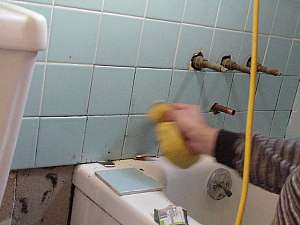
Take your sponge and wipe the grout from the face of
the tile and smooth the grout in the joints. Do not wipe too hard on the joints
or you will pull the grout from the joints. Clean your sponge often. Make sure
you use a bucket of water, not a sink.
After an hour or two, a haze will begin to form on
the tile. Using a rag or paper towel, polish this haze off. Make sure you do
not hit the joints as the grout is still soft. Let everything dry about a
day.
After 3 or 4 days it is a good idea to seal your new
grout. Water-based silicone sealers are available that provide good results.
Follow the directions on the container.
|

|